
Present, precise, spontaneous
Handle panel discussions confidently
Focused preparation for panels and public discussions with message training, simulation and professional feedback.
Marietta reviews every request personally and confirms the date and format.
Focus
Knowledge that becomes confident action.
The course combines academically grounded models with realistic exercises. Participants work on their own cases, receive precise feedback and develop solutions they can apply directly.
Who it is for
Universities & academia
Related programmes
Learning objectives
What participants develop
Get to the point
Handle attacks confidently
Show presence on a panel
Present yourself clearly, explain complex content accessibly and respond confidently to critical questions.
Universities and research institutions invest heavily in developing early-career researchers. Whether that investment translates into public visibility and impact depends on choosing the right formats. This programme specifically prepares researchers for panel discussions, panels and Q&A situations, with clear positioning, responsive confidence and language that reaches beyond their discipline.
Panel discussions have rules of their own.
Persuading people here takes more than good content. It requires clarity under pressure, conviction in the face of opposition, and the ability to remain present and connected even when exchanges become heated.
This is precisely what this coaching and training prepares you for. It helps researchers represent their expertise effectively in public and semi-public formats.
For universities, research consortia, graduate centres and scientific institutions, making research visible is essential. Presence and persuasiveness do not arise from good content alone. Competence is attributed by others, so what matters is how confidently and clearly researchers communicate their content and the value of their research to the outside world.
Impact in challenging discussion formats
It is especially important for researchers to prepare for panel discussions where they expect opposition: subjects inflamed by politics, media and populists, controversial panels, discussions with clearly opposing positions or critical questions from audiences and moderators. To persuade here, you must state your position and value clearly, quickly assess criticism and respond confidently to attacks. Even science itself is under pressure today.
Remaining constructive when the tone gets harsher takes all the more practice. This coaching helps researchers make an impact in challenging public discussions and represent their position confidently and persuasively.
 Clear messages matter in panel discussions
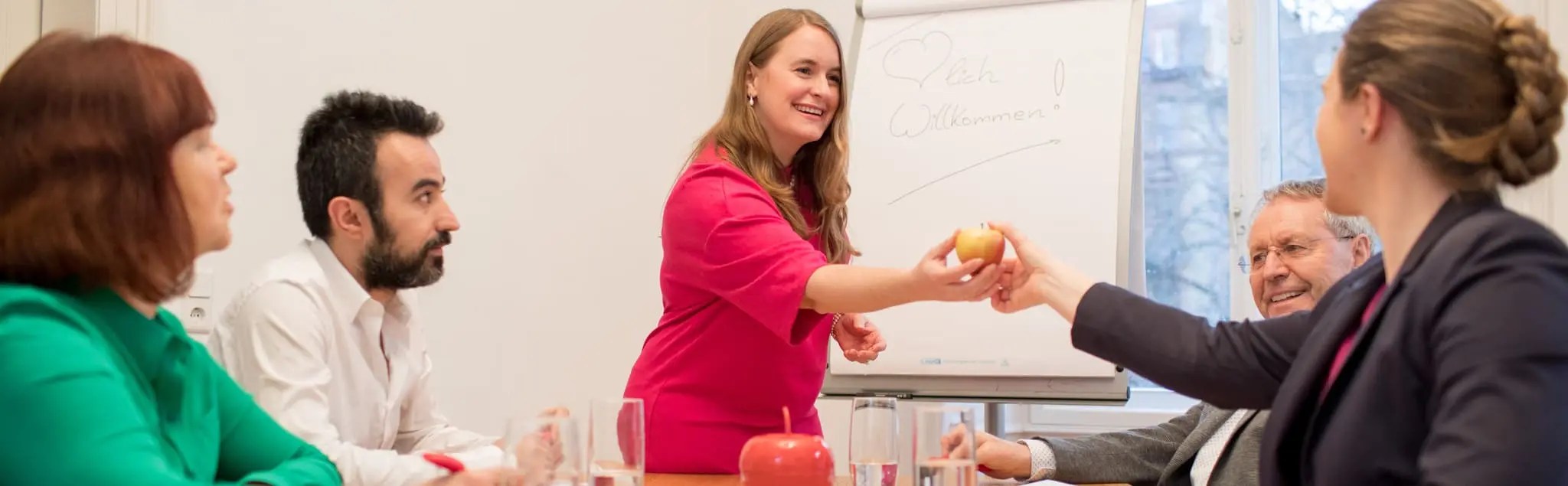
Source: vbw – Vereinigung der Bayerischen Wirtschaft e. V. / Photographer Stefan Obermeier
Competing for funding: make relevance visible
When competing for research funding in particular, it is vital to explain complex topics clearly, handle follow-up questions intelligently and make your research’s relevance tangible.
Getting your research across succinctly has special demands. Content must be condensed without losing accuracy. Different perspectives meet head-on. Follow-up questions are pointed, sometimes critical and sometimes from outside the discipline. At the same time, there is little time to build arguments or clear up misunderstandings.
This coaching helps you stay capable of acting in precisely these situations. It builds confidence for appearances where scientific quality, clarity and personal presence must come together.
Especially relevant for equality offices and mentoring programmes
Equality offices, mentoring programmes and early-career research initiatives often share a challenge: helping researchers become visible without reducing them to their outward image. Our panel preparation format addresses precisely this. It helps participants represent their expertise effectively in committees, panels and public Q&As, with clarity, presence and confident handling of critical or pointed questions.
Especially where visibility, hierarchy and gender roles interact, this preparation offers women a protected space to reflect on attacks and criticism involving gender bias, while targeted practice with new tools strengthens how they are perceived by others.
Preparing for a panel discussion: what changes in practice
After training and coaching, researchers face the challenge with confidence. They can:
- express their position more clearly and accessibly
- communicate complex content better to mixed audiences
- respond calmly and precisely to critical or pointed questions
- show greater presence in discussions without becoming unnecessarily rigid
- represent their expertise effectively even under time pressure
Who this format is for
We work online and in person with universities, research associations, graduate centres and scientific institutions throughout the DACH region that want to equip researchers from all disciplines for the often unfamiliar territory of appearing before large audiences or particularly important stakeholders. My programme is particularly suitable for:
- Researchers preparing for a specific panel discussion
- Researchers with public appearances in knowledge transfer, science communication or policy advice
- Doctoral and postdoctoral researchers who want to strengthen their public visibility
- Universities and scientific institutions seeking to prepare staff specifically for panels, conferences and discussion formats
- Graduates who need to persuade important stakeholders and require constructive critical feedback.
What we specifically prepare in coaching and training
I work with researchers on the critical points where panel discussions falter or succeed. These include clear core messages and the right storytelling to anchor those messages in listeners‘ minds.
Building on this, we train confident responses: methods for spontaneous, unexpected attacks and discussion-stopping phrases, alongside prepared lines of argument that specifically defuse typical attacks. In person, we use physical exercises to maintain confidence in the actual space, working on posture, eye contact and positioning. So even in opposition, the nonverbal message is: I stand firm.
Participants practise answering precisely under time pressure, taking up critical questions, assessing and reframing attacks, and expressing their position in ways that create clarity. This also includes work on voice, timing and strategic handling of moderation, dynamics and audiences.
The aim is a presence grounded in expertise, showing conviction and making an impact in conversation.
Formats
My programme is flexible, tailored to the occasion, audience and time available for optimal impact. The most frequently requested formats are:
- Individual coaching before a specific panel discussion
- Intensive sparring before panels or public appearances
- Compact preparation for talks with Q&A or knowledge-transfer events
- In-house training for research groups, graduate centres or programmes
- Workshops for science communication and public appearances
Every format is tailored to the occasion, subject area and role of the scientific appearance. The aim is preparation that creates clarity, builds responsiveness and equips researchers from all disciplines to handle the dynamics of real discussion formats.
With many years of experience in higher education
Marietta Gädeke has worked as a trainer, coach and moderator for more than 18 years, combining practical relevance with scientifically grounded approaches. She founded Lilit Kommunikation in 2008 while studying in Mainz and now works with universities, graduate centres and equality offices across Germany. Her previous scientific clients include GK AIPHES, GK KRITIS and the GRK 1657 Radiation Biology at TU Darmstadt, the graduate research programmes GRK 2344 and GRK2606-ProtPath at Universität Freiburgthat University of Bonnthat Universität Heidelbergthat Universität Mainz as part of FORTHEMthat Goethe-Universität Frankfurt, medical mentoring at Universitätsmedizin Mainz (MeMentUM, formerly the Edith Heischkel Mentoring Programme – EHMP), the Europa-Universität Viadrinathat Nürtingen-Geislingen University of Applied Sciences as well as the Universität Augsburg and its Office for Equal Opportunities. The German debating champion’s formats specifically address early-career researchers, doctoral and postdoctoral researchers and programme leaders who value quality, impact and conviction.
She also brings a rare combination to this topic: extensive experience in debate, moderation and strategic communication, clear expertise in gender and visibility issues, and substantial practical work with science, politics and demanding public formats. This is why her training combines substantive expertise with a strong public presence, without reducing researchers to performance alone.
Prepare for panel discussions — make an impact when it matters.
Are your researchers preparing for a panel, debate or another publicly visible format? Let’s use a no-obligation introductory conversation to clarify the dynamics they can expect, the communication challenges they should prepare for, and what coaching or training could help them enter that setting with clarity, presence and the ability to act.
Didactic structure
Analyse. Practise. Transfer.
- Clarify the situationGoals, roles and communication dynamics become visible.
- Test strategiesRealistic exercises create space for precise feedback.
- Secure transferConcrete next steps connect the course with daily work.
The next step